

How To Repair A Fiberglass Boat
How to Repair Fiberglass
Updated: Jun. 09, 2022
Ready boats, personal watercraft, even truck toppers with these fiberglass repair tips. Exercise information technology yourself and relieve thousands.
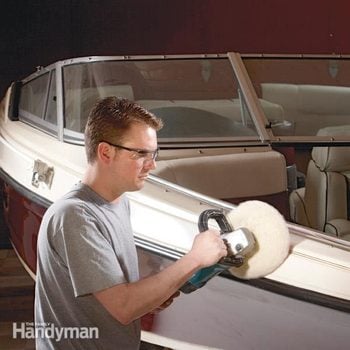
A repair pro shows you how to make invisible fixes for scuffs, dents and scratches in fiberglass boats and other fiberglass items. You'll save a ton of money if you lot're patient and utilise the proper tools.
You might as well similar: TBD
- Fourth dimension
- Complexity
- Price
- A full 24-hour interval
- Intermediate
- $101–250
Fiberglass Repair Overview: Price, savings and repair strategy
Even the best boat captain has had a docking plough into a scuff-and-chip event. But yous don't take to pay astronomical marina fees to get your boat fixed. Y'all can practice it yourself with advice from expert fiberglass gunkhole repair specialist Chris Hassis. He's stock-still boo-boos on fiberglass personal watercraft, snowmobiles and pickup toppers, and even luxury yachts. You'll need the right tools and materials—and lots of patience. Simply he'll prove you how to salve a ton of money on gunkhole fiberglass repair and brand your boat wait like new with some fiberglass boat repair tips. Nosotros were astounded at this refurbished boat's rebirth. The boat now looks every bit equally good as information technology did in the showroom after some fiberglass repair.
Most hired-out repairs of whatever type are roughly l percent labor and l percent materials. Non and then with this fix—hull repairs are all about labor. The repairs on this boat would cost roughly $3,000 at a shop. But the materials only cost about $250 and the buffer about $150! So roll up your sleeves. Your fiberglass boat repair might non exist perfect, just your gunkhole volition look unbelievably meliorate than it did before. Only don't attempt to rush or skimp on the materials. And know that this job is much bigger than it looks.
All fiberglass boats have a thick structural core of fiberglass strands impregnated with polyester resin. But the part you actually come across is the gel coat. That's the sparse layer of pigmented resin that gives the boat its sheen and color. Nigh low-cal scratches are in the gel glaze layer. They tin be sanded out and the area built support with new gel coat. But if they penetrate the core, they need to be filled. You can tell that the scratch is into the core if you meet fiberglass fibers (Photo 2).
Remove graphics
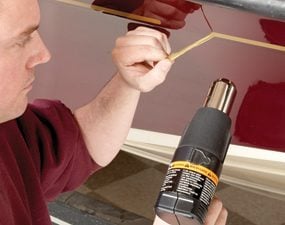
Photo 1: Remove erstwhile numbers and pinstripes to begin fiberglass repair
Ready the estrus gun to a low setting and pare off the old decals and numbers. Use agglutinative remover to become rid of any residue.
No boat spiff-upwards is complete without new license numbers, transom names and pinstripes. Merely do an online search for "boat graphics" and you'll find thousands of options to choose from. Find stripes by searching for "gunkhole pinstripes." Remove the erstwhile ones by warming them with a heat gun (Photo 1). But be careful—if you overheat the surface, you tin can burn the gel coat. If yours are painted on, sand them off with 1200-grit sandpaper.
Fix gouges: Prep
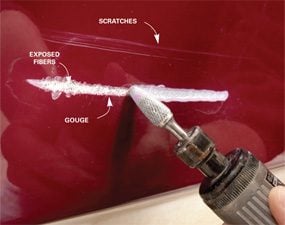
Photo ii: Prepare deep gouges
Cut a U-shaped groove into the gouge with a high-speed dice grinder or rotary tool and a burr nose bit. Taper the edges of the gouge to eliminate sharp edges in the old gel coat.
Grind out gouged areas with a V-shaped grinder fleck (Champion SF1; from heavydutystore.com; Photo ii). Sand out the low-cal scratches, starting with 80-grit, to 150-grit, and catastrophe with 240-grit.
Prepare gouges: Fill and smooth

Photo iii: Prepare the filler
Stir in enough chop to get the mixture to the consistency of peanut butter. Then add hardener (follow the manufacturer's ratio) and stir, stir, stir.
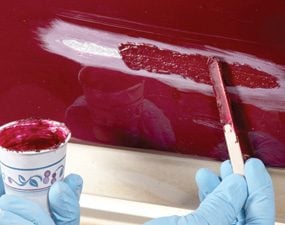
Photograph 4: Fill in the gouge
Scoop the gel coat putty into the gouge. Then printing it into the fibers with a craft stick. Add more putty until y'all're about 1/32 in. above the surface. Clean up any goofs with acetone.
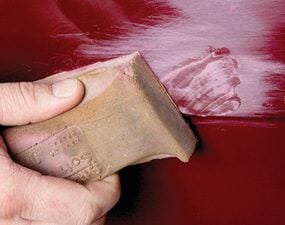
Photo 5: Sand the patch
Knock down the backlog putty with 80-grit sandpaper and a safe sanding cake. Then switch to 240-grit.
To ready gouges and deep scratches, y'all'll demand "chop" (powdered fiberglass) filler, gel coat and gel coat reducer. Jot downwards your gunkhole's model and serial numbers and contact the manufacturer to order gel coat (about $100 per qt.) to match your gunkhole's color. It may non be an verbal match, simply it'll be a lot closer than mixing colors from scratch. Then order some gel coat reducer (Patch-Assist is one brand; nigh $49 per qt. from minicraft.com or spectrumcolor.com) to thin the mixture enough to go through the spray gun. For gouge repair, y'all'll mix chop filler (Chris uses Cab-O-Sil from epoxy5050.com) with the gel coat to create a thick paste. And so pick up newspaper cups, stir sticks, acetone (for cleanup) and rags. You lot'll also need a dispensable spray gun (Preval is one brand; nearly $7 online or at pigment and art supply stores). To finish the job, you lot'll need a professional-blazon buffer. The variable-speed characteristic is important, and then is the high power of a professional buffer. So don't skimp on one or think you can go by with a $29 wax polisher. Apply a wool buffing pad (such as a Dewalt DW4988 pad, available through our affiliation with amazon.com or westmarine.com), and buffing compound (3M Regal Chemical compound and Finishing Material, which is what Chris uses, available through our affiliation with amazon.com or westmarine.com).
Mixing gel coat is a messy and stinky process—so wear chemical-resistant gloves, rubber goggles and a respirator. Outset with a small amount of gel coat and stir in the chop and hardener to make a putty that's the consistency of peanut butter (Photo 3). Once you lot add the hardener, y'all've only got a x- to 20-minute "open" time, then mix modest batches and work on one gouge at a fourth dimension. Thorough mixing is critical to proper curing. Spend a full infinitesimal stirring. If yous don't, you'll end upwards with patches of glutinous resin that can take days to harden.
Overfill gouges so the filler mounds slightly. You'll sand information technology affluent afterward it cures. Curing can take 1 to ii hours—depending on humidity levels. So exam it by touch on. If information technology's sticky, it'south non fully cured. Once it's fully hardened, sand information technology with 80-grit sandpaper (Photo v).
Color-Matching Gel Coats
Sometimes you can't get your easily on manufactory gel coat (your boat is too old or the manufacturer is out of concern). Then you take ii options. You tin can order an off-the-shelf colour that's close to yours and decide that "close enough is good enough." The other pick is to custom mix, but be aware that this is no like shooting fish in a barrel task. Purchase a color chip chart for off-the-shelf colors (from a local marine supplier, or get the No. 01900 color chart from rayplex.com for well-nigh $12). Mix your own colour with a kit (No. 33114; virtually $35) from rayplex.com.
Fix gouges: Apply the terminate
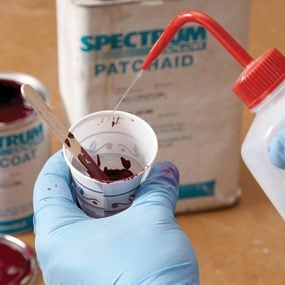
Photo six: Mix new gel glaze
Add the hardener after you've mixed in the reducer. Follow the manufacturer's recommended ratio of hardener to gel coat.
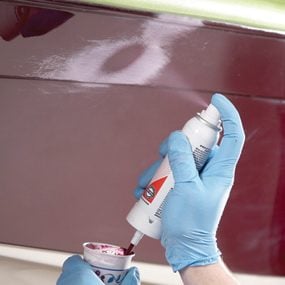
Photo vii: Spray on the terminal glaze
Pulse the sprayer to get short bursts of gel coat. Feather the spray forth the edges to reduce sanding.
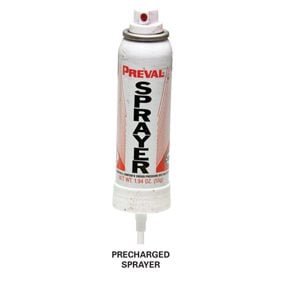
Photo 7A: Close-upwardly of sprayer
A pre-charged sprayer applies the last coat more smoothly than brushing, just you still have to sand it out.
At present y'all're ready to mix a fresh batch of gel glaze (without the chop) and spray the scratched and patched areas (Photos 6 and 7). Chris recommends using a disposable spray gun and paper cups. Unthinned gel coat won't get through the sprayer. Add the recommended amount of reducer (read label directions) and hardener and mix the ingredients. Spray the patched areas with short bursts. Spraying gel coat isn't similar spraying paint. It splatters on and has to be sanded and buffed to get to a shine gloss. So don't be disappointed that the terminate isn't pigment-like right abroad during your fiberglass boat repair.
Final-sand, buff and wax
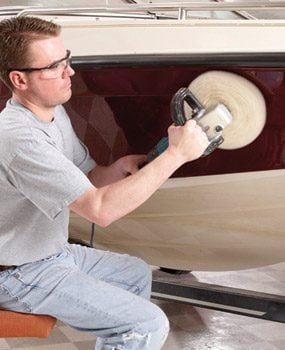
Photo 8: Vitrify to a great polish
Take a seat and heft the buffer into position. Start slowly and vitrify small sections at a time.
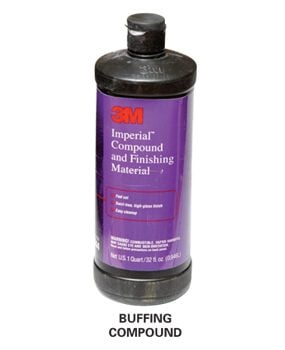
Photograph 8A: Close-upwards of buffing compound
Buffing compound produces a silky polish finish.
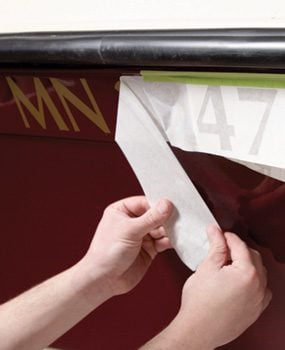
Photo 9: Utilise new decals
Position the new boat numbers and tape the sheet in identify. Then lift the sheet up, remove the capitalist and press each number individually. Don't try to use them all at in one case—they'll wrinkle.
Look for the gel coat to cure. Sand the repairs with 600-dust and so 800-dust sandpaper. For the perfect finish, sand with 1,200-dust wet/ dry paper and then vitrify (Photo 8). Apply buffing compound directly to the pad. Piece of work on a two ten 2-ft. surface area and utilize light to medium pressure at a fairly low speed. Reduce pressure level as the compound starts to dry. Wipe off the haze as you go. Apply the graphics and and so wax.
Gild of Events for Fiberglass Gunkhole Repair
Wash and rinse the boat. That will testify you all the dings that need fixing. Mark them with masking tape then you won't forget any.
If you're replacing pinstripes, license decals or other graphics, remove them next.
Fill up any deep gouges and spend your fourth dimension sanding out scratches while the filler sets up.
Apply gel coat to the filled gouges and finish to the scratches and and so last-sand the filled gouges.
Buff all the repaired areas and then the residuum of the boat.
Apply any graphics to terminate upwards.
Required Tools for this Boat Fiberglass Repair Project
Accept the necessary tools for this DIY boat fiberglass repair projection lined up before yous start—you'll save time and frustration.
You'll also demand a variable speed buffer, wool buffing pad, chemical-resistant gloves, respirator and a burr-nose grinder chip.
Required Materials for this Boat Fiberglass Repair Projection
Avert last-infinitesimal shopping trips by having all your materials fix ahead of time. Here'southward a listing.
Originally Published: November 26, 2022
Source: https://www.familyhandyman.com/project/how-to-repair-fiberglass/
0 Response to "How To Repair A Fiberglass Boat"
Post a Comment